Materialen
What our socks are made of, and how we arrived at every number
This page is the basis for every percentage on this site. If a claim on a product page is not supported here, treat the product page as wrong and tell us.
Last updated 15 August 2026 · STAR SOCK B.V. · Dutch law
1. What the percentage means
Every recycled percentage on this site is a share of yarn weight: the weight of recycled fibre in the yarn used to knit the sock, divided by the total weight of that yarn.
It is not a share of the finished sock. Sewing thread, the elastic in the cuff, labels and any finishing are outside the measurement. We use the yarn basis because it is the one our suppliers can declare per batch, which means you can ask us to show our working and we can.
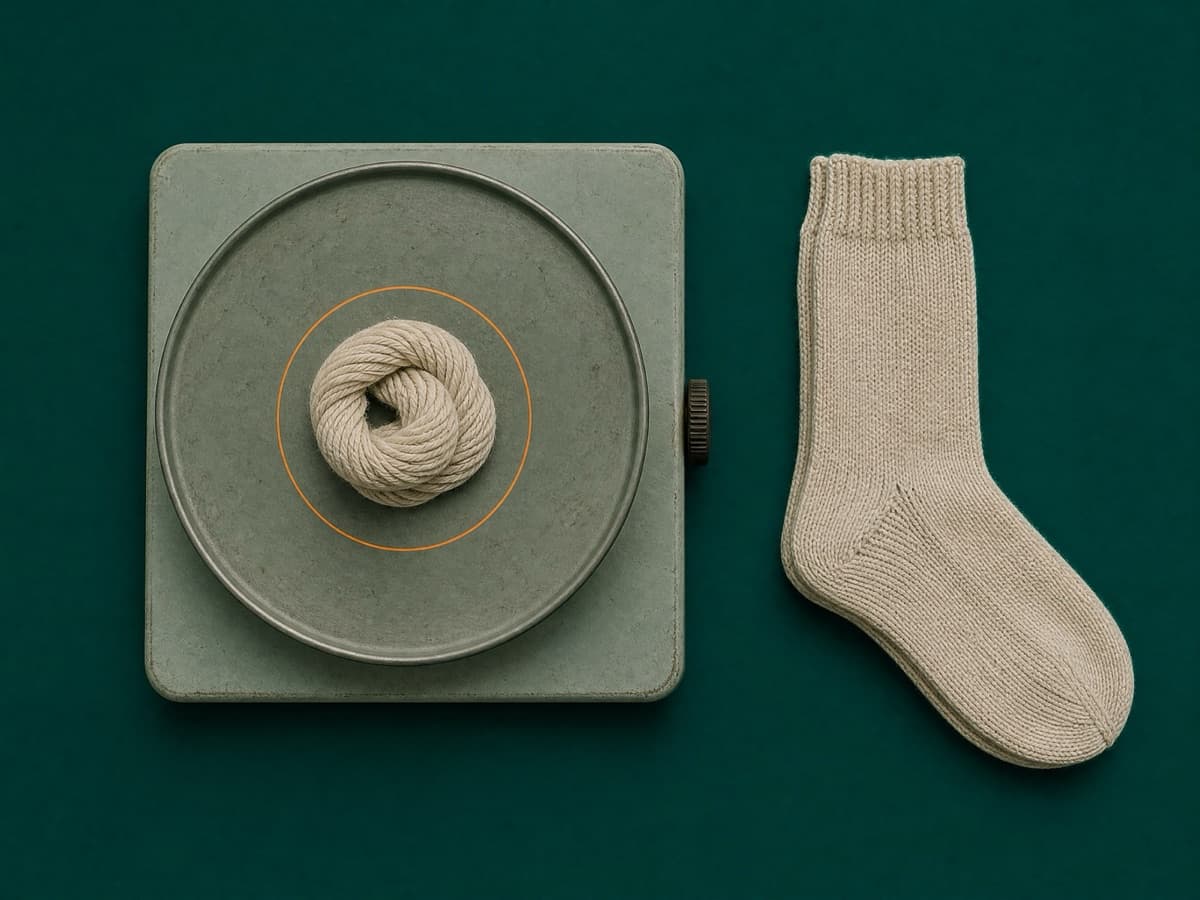
Across the 42 products the recycled share runs from 12% to 84%. There is no range average anywhere on this site, because you do not buy a range.
2. Source categories
Recycled fibre reaches us in three categories. We state the category and stop there.
- Reclaimed fishing gear — discarded and collected technical netting and cordage, shredded as feedstock for polyamide.
- Textile waste — cutting-room and spinning waste from garment and yarn production, reopened into cotton fibre.
- Reprocessed wool — wool pulled from collected knitwear, sorted by colour family and re-spun without re-dyeing.
We do not name a sea area, a port, a collection point, a mill or a supplier site. Not because those details are secret, but because we cannot verify them, and an unverifiable detail printed next to a number makes the number look more solid than it is.
3. How material becomes fibre again
Mechanical recycling tears textile back into loose fibre. It is the route used for our recycled cotton and recycled wool. It shortens the fibre, which changes how the yarn behaves — see sections 7 and 8.
Chemical recycling breaks the polymer down to its building blocks and re-forms it. It is the route used for the polyamide in Line A. Staple length is not lost this way, which is why our highest recycled shares sit on that line.
Not disclosed. For a small number of batches the yarn supplier has not told us which route was used. Those products say “processing route not disclosed” on the product page and in the trace. They do not get a guess, and they do not get quietly dropped from the range either.
4. The share that is not recycled
Every product page lists the share that is not recycled, broken into its actual fibres, at the same size and in the same style as the recycled share. In the bar graphics both parts are drawn solid and at the same height, and the colour used for the non-recycled part is deliberately the brighter of the two.
That is a design decision with a reason behind it. Fading the remainder, drawing it thinner, or marking it with a warning colour would tell you that one part of the sock is a problem and the other is a virtue. That is a judgement, not a fact, and we do not have the evidence to make it.
In practice the non-recycled share is conventional cotton, conventional polyamide, conventional wool and elastane. Elastane is in every sock we make, at 3% to 4%, because without it a sock does not stay on a leg.
5. The lowest line stays on the site
These have the lowest recycled content we sell. We list them because leaving them out would make our range look better than it is.
Line E runs from 12% to 25% recycled content. It is the cheapest line we sell and the least impressive number on the site. It appears in the same filters, at the same card size, with the same photography and the same bar treatment as Line A.
Removing it would raise every summary figure we could quote about this range. That is exactly why it stays.
6. Third-party certification
No product on this site holds third-party certification. No standard body has audited the recycled content of these yarns on our behalf. Every product page states this in words rather than leaving the field empty, because an empty field reads as an oversight and this is not one.
What we have instead is a per-batch declaration from the yarn supplier, which is what the percentages on this site are based on. If that changes — if a standard is obtained for a specific yarn — the standard will be named on the affected products with its certificate reference, and not one product more.
We do not display self-made emblems, leaf marks, circular arrows or any other graphic that could be mistaken for a certification. The only mark on this site is our own grid, and it certifies nothing.
7. Fibre names
Fibre names on this site are the legal ones under EU Regulation 1007/2011, listed by weight in descending order: cotton, wool, polyamide, elastane.
Where a fibre has a marketing name that differs from its legal name, we use the legal name. A regenerated cellulose fibre is viscose on this site regardless of the plant it started as.
8. What recycled cotton changes
Mechanical recycling shortens cotton fibre. Shorter staple means a yarn that is less even, feels coarser, and wears through sooner than a virgin cotton yarn of the same count. The higher the recycled share, the more noticeable this becomes.
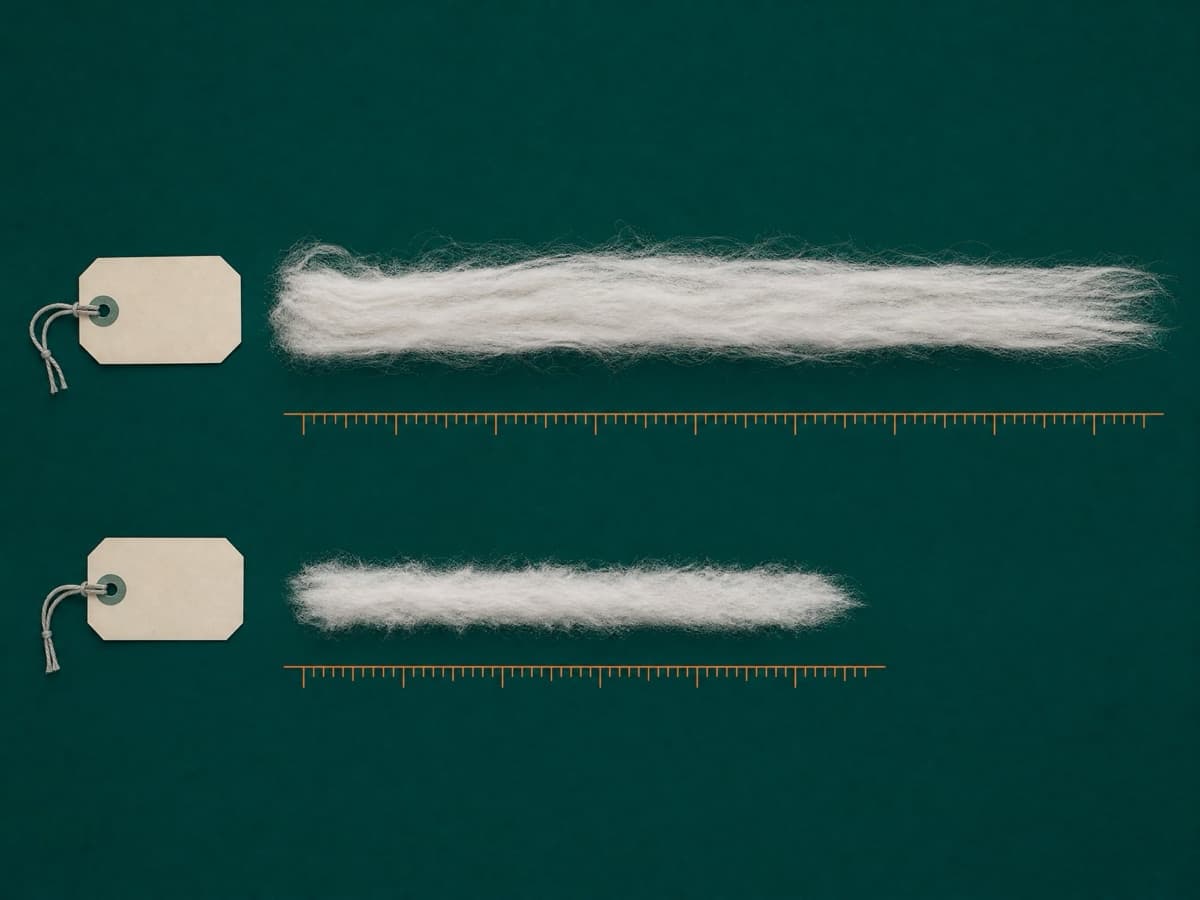
This appears on every Line B product page. It is stated as a property of the material, not as a defect and not as an apology. If you want the longest wear from a cotton-led sock, buy a lower share on that line and know why.
9. What reprocessed wool changes
Reprocessed wool is not re-dyed. The fibre going into the yarn was dyed by someone else, years earlier, in colours we did not choose. Sorted by colour family and spun together, it produces a heathered yarn whose shade varies between batches by up to 5%. Two pairs bought months apart will not match exactly.
Wool also shrinks irreversibly above 30 °C and in a tumble dryer. Every wool-containing product page carries the wash temperature and a dry-flat instruction.
10. What this site does not say
Four things are deliberately absent from every page here.
- No comparisons. There is no “versus an ordinary sock” section anywhere on this site. A fair comparison needs a defined reference product and a method, and we have neither.
- No future targets. We make no promises about what this range will be in five years. A target with no method behind it is a sentence, not a commitment.
- No collection totals. We do not publish tonnages recovered or pairs collected. We run no take-back scheme. If one is ever set up, it will be described here after it exists, with the party operating it named.
- No performance claims from the recycled content. Recycled fibre is not presented here as stronger, warmer, healthier or more hygienic than conventional fibre. Where a fibre is chosen for a property, the page states the reason for the choice and stops before the conclusion.
11. Textile waste registration in the Netherlands
Dutch extended producer responsibility for textiles (UPV Textiel) applies to parties placing textile products on the Dutch domestic market. This store sells worldwide in USD and does not currently place products on the Dutch domestic market.
If that changes, registration with Stichting UPV Textiel will be completed before any such sale and the registration number will be published on the juridische informatie page. We have not registered a number, and we do not display one.
12. Corrections
Numbers change when supplier declarations change. When a percentage on this site is corrected, the product page carries the corrected figure and the date it changed. We do not silently amend a number and leave the page looking untouched.
If you believe a figure here is wrong, write to support@starsocknl.rest and say which product and which figure. That is a faster route to a correction than any form.
Contact: support@starsocknl.rest · +31 13 5231400
See also: Juridische informatie · Herroepingsrecht · Verzending en retour